Standard or Custom? A Mid-Market Manufacturer's Guide to Choosing the Right Robotic Platform Without Overpaying or Underbuilding
The sales presentations are compelling in both directions. The off-the-shelf robotics vendor emphasizes rapid deployment, proven reliability, and a lower upfront price point. The custom engineering firm promises a solution built precisely for your workflow, your tolerances, and your long-term growth trajectory. Both arguments contain genuine merit. Both also contain incentives that do not perfectly align with your interests.
For mid-market U.S. manufacturers—companies with annual revenues between $10 million and $250 million, operating one to five production facilities—the choice between standardized and custom-engineered robotic solutions is not merely a procurement decision. It is a strategic one that will shape operational capacity, capital allocation, and competitive positioning for the next decade.
Making it well requires moving past the vendor narrative and into a structured analysis of your actual requirements.
Defining the Spectrum
Before establishing a decision framework, it is useful to clarify what these terms actually mean in practice, because the market presents a continuum rather than a binary choice.
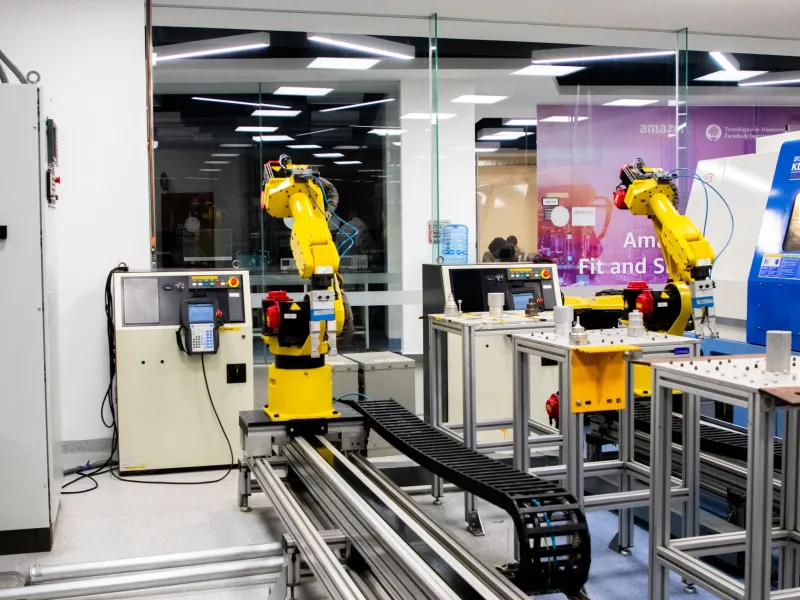
Off-the-shelf platforms refer to robotic systems that are designed, manufactured, and sold as standardized products with defined specifications. Collaborative robots (cobots) from manufacturers such as Universal Robots or FANUC's LR Mate series fall into this category. They are highly capable, widely supported, and can often be deployed within weeks of purchase. Their limitations relate primarily to application specificity—they are designed to perform well across a broad range of tasks rather than to excel at any single one.
Lightly configured systems occupy the middle ground. A standard robotic arm combined with a custom end-of-arm tooling (EOAT) package, a purpose-built fixture, and application-specific programming represents this category. Much of the base platform is standardized; the integration layer is customized. This is where the majority of mid-market automation projects actually live.
Fully custom-engineered solutions involve designing automation systems from the ground up to meet specifications that no standard platform can adequately address. These projects are appropriate for highly specialized applications—unusual payload geometries, extreme environmental conditions, proprietary process requirements—but they carry substantially higher development costs, longer lead times, and greater implementation risk.
When Standardized Platforms Deliver Superior Value
The economic case for off-the-shelf or lightly configured robotic systems is strongest when several conditions are present simultaneously:
Your process is relatively standard. If your application involves pick-and-place operations, palletizing, welding on common joint geometries, or packaging in conventional formats, the probability that an existing platform can meet your requirements at high performance levels is very high. Attempting to custom-engineer a solution for a standard application is a reliable way to spend 40 to 60 percent more than necessary.
Your production volumes are moderate and variable. Standardized platforms are generally easier to reprogram and redeploy across different product lines. For manufacturers with significant SKU diversity or seasonal production variability, this flexibility has real dollar value that custom systems often cannot match.
Speed to deployment is a competitive priority. A standard robotic cell can typically be commissioned in four to twelve weeks. A custom-engineered system may require six to eighteen months from initial design to production readiness. In markets where speed matters, that time differential has direct revenue implications.
Your maintenance infrastructure is limited. Standard platforms benefit from broader technician familiarity, readily available spare parts, and manufacturer support networks that custom systems cannot replicate. For facilities without dedicated robotics engineering staff, this support ecosystem significantly reduces operational risk.
When Custom Engineering Earns Its Premium
The investment in custom-engineered automation is justified under a different set of conditions—and the key word is investment, because the upfront cost differential is real and should be evaluated against specific, quantifiable returns.
Your process has genuinely unique requirements. Certain manufacturing applications involve material properties, dimensional tolerances, environmental constraints, or process sequences that no standard platform handles adequately. A medical device manufacturer working with sub-millimeter tolerances in a cleanroom environment, or a specialty chemical processor requiring explosion-proof robotics in a solvent-heavy atmosphere, has legitimate requirements that standard platforms cannot meet without compromise.
Your production volumes are high and stable. When a facility runs the same product at high volume for years at a time, the performance optimization achievable through custom engineering can generate cost savings that far exceed the development premium. A custom EOAT designed for a specific component geometry may reduce cycle time by 15 to 20 percent compared to a generic alternative—a difference that compounds meaningfully over millions of production cycles.
Competitive differentiation depends on process capability. For manufacturers whose market position rests on quality attributes that are directly tied to process precision, investing in custom automation that achieves performance levels competitors cannot replicate is a strategic expenditure, not merely a capital cost.
A Decision Matrix for Mid-Market Manufacturers
The following framework provides a structured starting point for evaluating which approach fits a given application. Score each factor on a scale of one to five, where higher scores favor custom solutions:
| Factor | Score 1-2 (Favors Standard) | Score 4-5 (Favors Custom) |
|---|---|---|
| Process uniqueness | Common, well-documented application | Proprietary or highly specialized process |
| Annual production volume | Under 100,000 cycles | Over 1 million cycles |
| Product line stability | High SKU diversity, frequent changes | Single product, stable design |
| Performance tolerance requirements | Industry-standard tolerances | Sub-standard or proprietary tolerances |
| Deployment timeline | Under 6 months required | 12+ months acceptable |
| Internal engineering capacity | Limited robotics expertise | Dedicated automation engineering team |
Applications scoring below 15 across all factors are strong candidates for standardized platforms with light configuration. Those scoring above 22 warrant serious evaluation of custom engineering. The range between 15 and 22 represents the middle ground where lightly configured systems typically offer the best balance of performance and cost.
The Over-Engineering Trap
One of the most common and costly mistakes mid-market manufacturers make is specifying custom solutions for applications that standardized platforms handle adequately. This pattern typically emerges from one of two sources: vendor-driven scope expansion during the sales process, or internal engineering teams that find the intellectual challenge of custom design more engaging than the pragmatic case for standard deployment.
The consequences are financial and operational. Over-engineered systems cost more to build, take longer to commission, require more specialized maintenance, and often introduce complexity that reduces rather than improves reliability. A manufacturer that spends $800,000 on a custom robotic cell for an application that a $180,000 standard platform would have handled at 95 percent of the performance level has not made a precision decision. It has made an expensive one.
The Undersizing Trap
The opposite error—selecting standardized platforms for applications that genuinely require custom capability—carries its own costs, though they tend to materialize more slowly and are therefore harder to attribute accurately. A robotic system that performs adequately but not optimally for a high-volume application generates a performance gap that compounds over time. The cost is not a single invoice; it is a persistent drag on throughput, quality, and competitive position.
At NVS Robotics Bhopal, our approach to this decision begins with application analysis rather than platform preference. The goal is to identify the solution that delivers the required performance at the lowest total lifecycle cost—whether that solution is standard, lightly configured, or fully custom. The distinction matters less than the fit.
Making the Call With Confidence
The manufacturers who navigate this decision most effectively share a common discipline: they define performance requirements before engaging vendors, not after. When you know precisely what cycle time, tolerance, uptime, and flexibility your application demands, the platform decision becomes substantially more objective.
Bring that specification to every vendor conversation. Evaluate proposals against requirements, not against each other's feature lists. And apply the same rigor to total lifecycle cost—including maintenance, support, and eventual upgrade paths—that you apply to upfront capital expenditure.
The right robotic solution for your facility exists somewhere on this spectrum. Finding it requires clarity about where you are, where you are going, and what performance level actually moves the needle for your business.